AI's Labor Problem
Exploring problems and tensions. But are there solutions in sight?

TLDR:
The value proposition of AI has rapidly shifted in recent months, from an extra human appendage and superpower to human replacement. Investors and founders are discussing that more and more.
Its use in automating information work, dulling the need for junior talent, and disrupting traditional education (and assessment), is having immediate, far-reaching impacts today.
Forward-looking investors and founders see the opportunity in this chaos: reimagining education and individualized instruction, extending nonexistent human capability for supply-constrained industries and employers, and making government and care more readily available.
Investors have a responsibility: where you choose to allocate capital makes more probable a different set of futures for industry and humanity. Put more bluntly: investing in a better society is patriotic.
Where we are today
My parents have worked every “frontline” job under the sun across 2 different countries, from teacher to cab driver to security guard to USPS mail handler to Wendy’s cook to aircraft cleaner. Uncommon family heritage for a VC, I know, but it informs my thinking about what’s broken in the US economy and the types of technological transformations needed in that system. At Uber, my time launching and managing markets, fine-tuning driver experience and funnel, and modeling high-ROI incentive and pricing systems also informs that. All of that has made me deeply interested in recent advancements in AI and the corresponding capital that has both fueled and chased it. USV likes to say that they invest at the edge of social and technological change, which is both inspiring and aspirational. Social and technological change undergirds my thesis in Economic Infrastructure, which often has me investing at the intersection of software and labor.
Speak to anyone investing in the space, privately or off-the-record, and you’ll find that they are grappling more intensely with a few emerging problems and tensions inherent in the AI - Labor paradigm. It now feels right to begin that discussion publicly. The past few weeks of news have indicated a “thawing” in that conversation, where public declarations of blanket techno-optimism have met data that challenges those expectations, inspiring a more open discussion about AI’s Labor problem, both for white-collar and blue-collar jobs.
AI is here and dramatically reshaping the US labor market today, not in a distant future.
There’s a very worrying trend in the job market today impacting new grads and early-career professionals. As Derek Thompson put it in the Atlantic, “We're seeing the worst delta between overall unemployment and new-grad unemployment in at least 40 years,” with some believing it's an early sign of AI eating jobs usually done by young people. New grads are accessing unemployment insurance at previously unforeseen rates and living at home longer than more recent generations. Anecdotally, a mentor’s son graduated from a prestigious California engineering school with a CS degree and struggled significantly to find a job. Entry-level work is being squeezed and many employers are finding automation more enticing than training.
CEOs are beginning to share, much more openly and vividly, their expectations for AI use at their companies. From Shopify to Duolingo and Fiverr, the recommendations range from forceful to forward-looking to ominous. While some argue that this is a good and helpful thing, many workers contend that this might be pretense for future firings.
It’s not just journalists and CEOs: VCs are beginning to shift their public remarks and open the kimono on their own private concerns around the scale and speed of labor automation.
Charles Hudson (Precursor): “From everything I’ve seen, the rise of AI is replacing labor with machines and agents because they can do most, but not yet all of the work. As is the case with any innovation, the optimist in me wants to believe that this new tech wave will create new job categories and titles that didn’t exist before, but this wave feels different...”
Harry Stebbings (20VC): “The biggest lie we are all telling ourselves: AI will not lead to mass unemployment, it will just make us more efficient. Simply not true. Mass unemployment is coming to sales, marketing, customer support, success. We have to face reality.”
Pat Grady (Sequoia) telegraphed this in 2024: “The cloud transition was software-as-a-service. Software companies became cloud service providers. This was a $350B opportunity. Thanks to agentic reasoning, the AI transition is service-as-a-software. Software companies turn labor into software. That means the addressable market is…in the trillions of dollars.”
Even the new Pope is chiming in: “In our own day, the church offers everyone the treasury of its social teaching in response to another industrial revolution and to developments in the field of artificial intelligence that pose new challenges for the defense of human dignity, justice and labor.”
Learning to code, or do “AI”, is not a panacea. Just ask software developers.
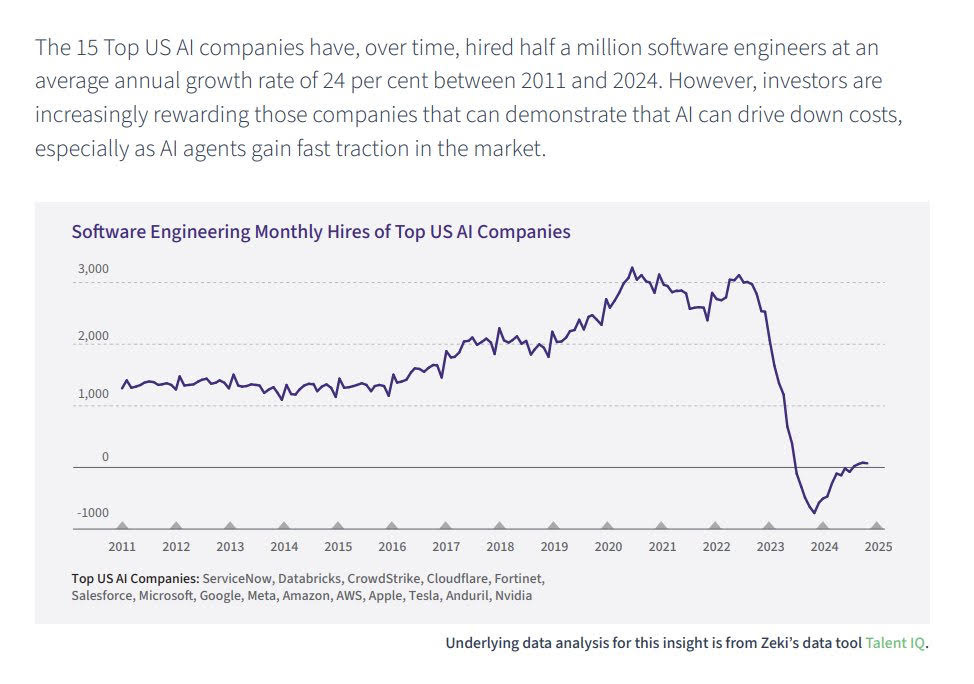
Software development hiring has significantly lagged general hiring in the post-COVID era, with many CEOs arguing that coding copilots (enter Windsurf’s $3B acquisition by OpenAI) can do the job of most entry-level engineers.

Software development hiring EVEN AT the highest-growth AI companies in the US has fallen off a cliff, and it’s not all explained by the venture downturn of 2022.
Education has generally been seen as a critical stopgap during disruptions. But the implications for today’s education system are dire.
New York Magazine profiled dozens of students who highlight that all of their classmates are cheating their way through college. Young people are at this stage in a prisoner’s dilemma whereby using AI to cheat (on essays, coding assignments, math, etc.) is necessary to keep up with others (or so it seems to them). A study published in June 2024 used fake student profiles to pass off 100 percent AI-generated work into a U.K. university. The professors failed to flag 97 percent. This is a crisis.
CEOs and nonprofit leaders have noticed and are sounding the alarms in their own ways, including asking the Trump Admin to mandate CS for HS graduation. 11 states currently have some CS requirement but only 6.4% of all HS students take CS classes today. While coding is not a panacea, maybe it raises the bar for what students should know ahead of graduation.
Investors who spend a lot of time at the intersection of software and labor transformation (enhancement, productivity, safety, compliance) have to navigate new tensions in vision and underwriting.
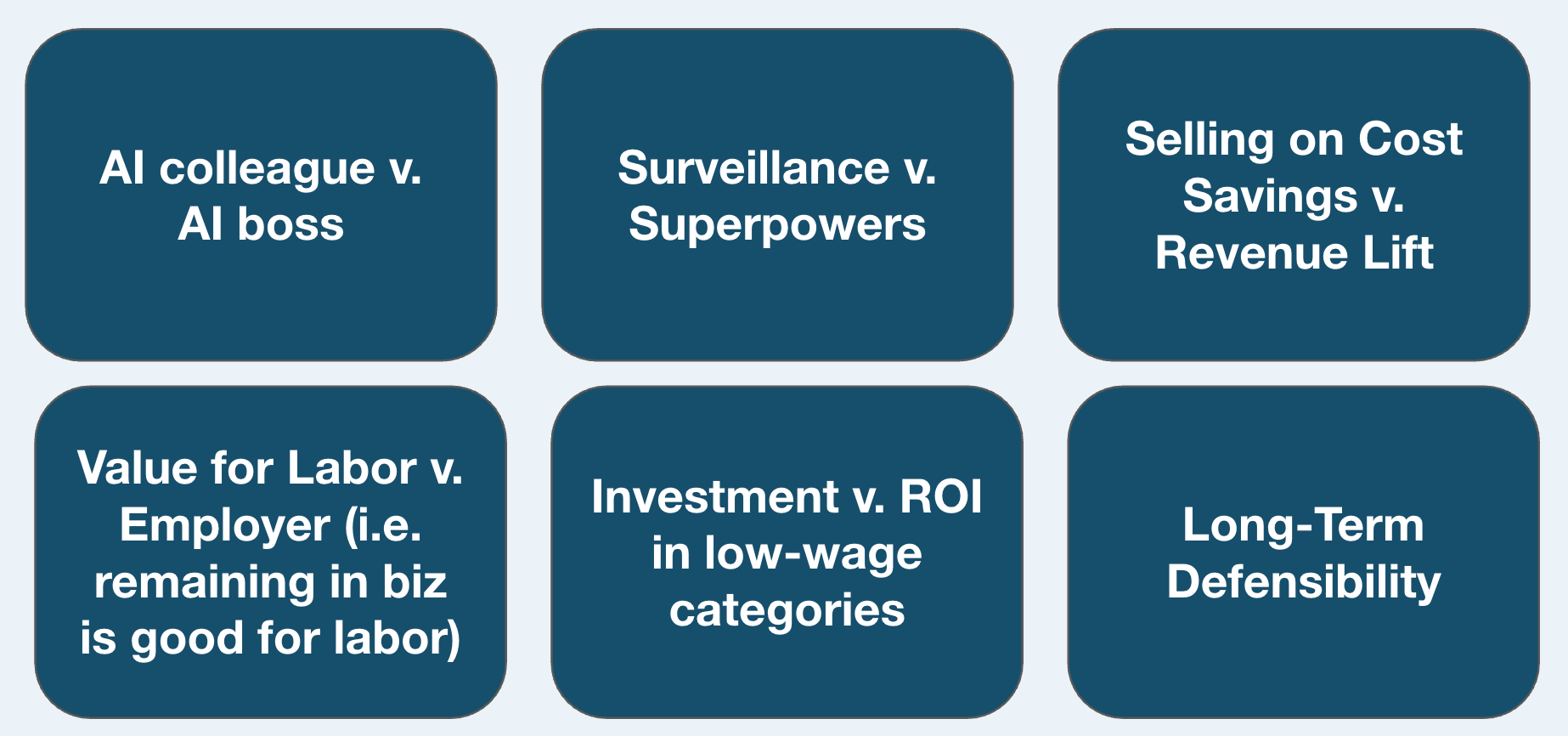
For many AI applications for the field, what may be sold to workers as a “superpower” is sometimes viewed as helpful surveillance by management. Do agents create a helpful AI colleague or a faceless AI boss? Call center workers have reported feeling the latter, or as one Filipino call center worker shared: “AI is supposed to make our lives easier, but I just see it as my boss.”
Winning messages in pitch decks may differ from those in board rooms: investors may bite on the “revenue uplift” potential of a solution but buyers may see more value in “cost savings.” Often, the path to achieving the former is more challenging than the latter. What inspires you dictates what you invest in.
While many startups have spent the last 5 years building automation tools for the information worker (and increasingly acting as the information worker) because of their existing higher salary base, the pressure to automate remains less clear for low-wage, supply-crunched industries (e.g. construction, energy, some healthcare). But VC investment remains firmly attached to the former, even as 70% of labor resides in frontline industries.
The trends above are surfacing emerging opportunities to reimagine the world, albeit more positively.
YC’s call for Startups for its summer 2025 batch showcases some of what people are thinking about, with a heavy focus on learning and upskilling.
The Future of Education: “We're just starting to see new personalized study tools for students and grading platforms for teachers, but we're still very early in figuring out what AI can truly achieve here. One big challenge is figuring out the business model.”
AI Personal Tutor for Everyone: “And today, with AI, we think it's finally possible to build a truly personal tutor for everyone. The latest reasoning capabilities let them break down complex topics step by step, in a way that should help explain even the most complicated subjects in a straightforward way.”
VCs are in the business of optimism. In thinking about the thousand pitches I’ve heard in this space, I have found several inspiring AI Labor use cases:
Tooling that enables field services staff to debug technical problems (e.g. energy) or anticipate and rapidly respond to safety issues (e.g. construction) AKA nextgen GPT for the Field
Platforms that extend the superpower of individualized college advising (reserved for the privileged few) to every student who wants it, right down to their desired classwork, out of pocket tuition burden, living circumstance, and alignment with personal story AKA nextgen Chegg
Co-pilots that take the guesswork out of real-time diagnostics or enable a caregiver to rapidly get-up-to-speed on a person’s conditions and needs (e.g. home health) AKA nextgen Wellsky
Agents that dramatically expand an organization’s ability to do the hassle-laden work of making phone calls to verify someone’s benefits status (e.g. Medicaid and low-income populations) AKA nextgen UniteUs
Digital employees who give small businesses the talent and capabilities of someone they can’t attract, hire, and pay today in functions they can’t staff (e.g. a digital marketer, a sales rep, an accountant, a copywriter, a CFO) AKA nextgen Servicetitan
Operating systems that enhance local and state government’s ability to deliver personalized, 24/7, multimodal customer service for information, support, and transactions (e.g. unified voice agents and text agents) AKA nextgen Tyler Tech / OpenGov
Why don’t we end on a note of inspiration?
I recently welcomed 2 newly-immigrated relatives to the US. One is 19 and attempting to get his GED while searching for work at a restaurant. His English skills are admittedly weak. Another has entered 7th grade and is struggling to get up-to-speed in English literacy, despite ESL coursework. I spent 10 minutes with each of them showing them how to prompt ChatGPT via voice, in our own dialect. For example, we asked for its help in navigating their issues while learning basic English (e.g. saying in Arabic, “Hi ChatGPT, I want to learn the top 100 English phrases to help me land a job at a restaurant and I don’t know any English. Please help me!”). It was breathtaking for me to do this and for them to have a conversation with AI, in their own language and dialect (Egyptian Arabic is VERY different than other Arabic), to build up their English skills. My hope is that more of this emerges, whether organically or otherwise, as economic dislocation ensues.
I write this as an entry-point in a longer dialogue I’d like to have in public, with founders, investors, and maybe even my old colleagues who are still policymakers on what to do about the AI Labor problem. In the last month, such private conversations with friends in VC have intensified as more pitch decks sold “cost-cutting” and fewer painted the inspiring vision of “giving people superpowers.” Of course, investors have a duty to their LPs, partners, and founders first and foremost, but they’re not blind actors, living and working in a vacuum. Where you choose to allocate capital makes more probable a different set of futures for industry and humanity: what a frightening, humbling, and exciting power to have. A trite Luddite mindset doesn’t make sense but neither is a mindless, laissez-faire approach that divorces investment decisions from public responsibility. More pointedly, I believe investing in a better society is patriotic. After all, even Henry Ford believed business should serve labor and the public good, which happened to help him sell more cars. If enough of your employees can’t buy or use your product, then maybe rethink what you’re building entirely. That should hold true for founders and investors alike.
If you’d like to talk about these issues or challenge my perspective, especially if you’re building at this exact tension point, please reach out: youssef@alleycorp.com.